Recycling collection is coming to Mackenzie County in October 2026!
Starting in October, 2026, Mackenzie County will be receiving new recycling services.
This new service will be managed by Circular Materials, a national not-for-profit that is leading Alberta’s transition to Extended Producer Responsibility (EPR).
EPR shifts the financial and operational responsibility of recycling programs to producers – those that produce and supply packaging and paper materials to residents. This includes the familiar brands and retailers Albertans interact with every day. This new approach to recycling means municipalities and taxpayers will no longer pay for the bulk of recycling services as this cost will now be paid by producers.
There is no extra fee for this program. It’s paid for through the Extended Producer Responsibility Program. (Which you already pay for through the products you buy).
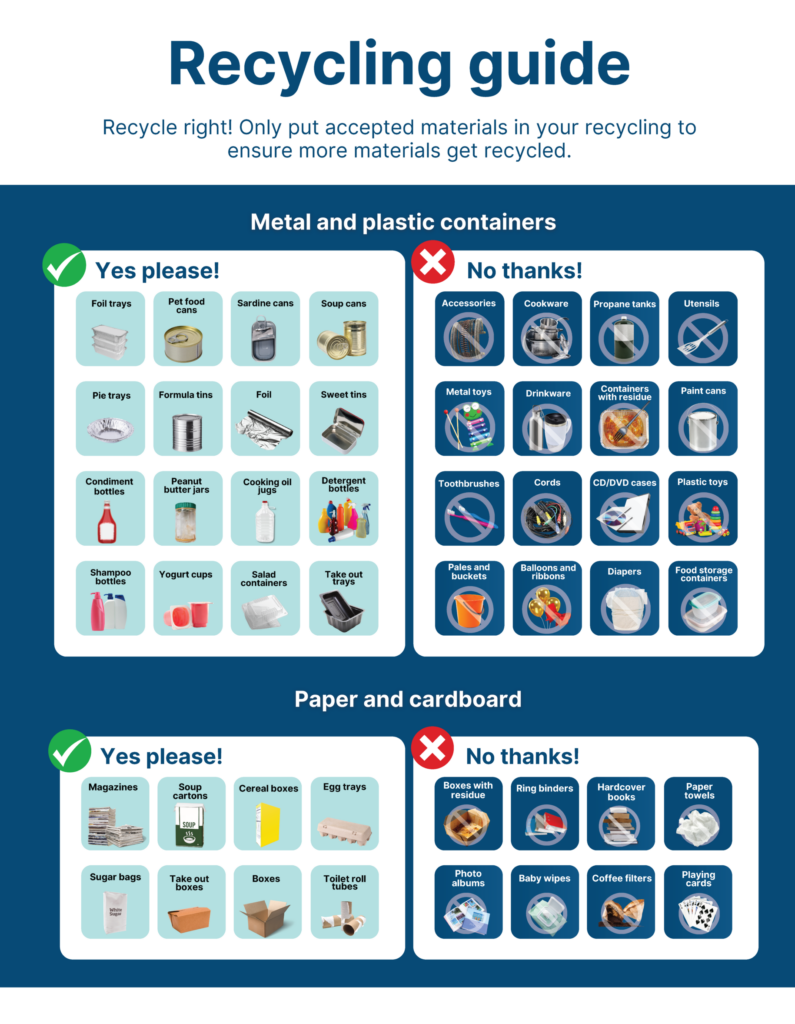
Soon you will be able to recycle more materials like glass containers, foam packaging, flexible and rigid plastic, cardboard and paper and metal containers and packaging right at your curb or at the Edson Recycle Depot.
The transition will introduce a more convenient, consistent, and effective recycling program across the province – a change that will not only benefit people, but also the province.
More information on the new recycling program will be shared here in the coming months.
What can I expect during the transition?
Additional materials such as foam packaging, glass containers, flexible plastic packaging and aerosol containers will be added to the province’s collection system starting in October , 2026. Residents will also be receiving new curbside recycling services, managed by Circular Materials through a third-party contractor.
Alberta residents can visit circularmaterials.ca/AB to learn more about recycling in their community. Additionally, Circular Materials is launching the Circular Materials Recycling App across the province where residents can get recycling collection reminders, recycling guides and service alerts.
What’s happening to Alberta’s recycling program?
In 2022, the Alberta government passed a new regulation which introduced an extended producer responsibility (EPR) framework for single-use packaging and paper products (PPP) in the province. EPR shifts the financial and operational responsibility of recycling programs to producers – those that produce and supply packaging and paper materials to residents. This includes the familiar brands and retailers Albertans interact with every day. This new approach to recycling means municipalities and taxpayers will no longer pay for the bulk of recycling services as this cost will now be paid by producers.
EPR enables innovation, operational efficiencies, increased standard levels, and access to materials. It is recognized as one of the most effective mechanisms to improve recycling rates.
How does Circular Materials fit into this?
Circular Materials is a national not-for-profit organization that is committed to building an efficient and effective recycling system in Alberta. Circular Materials is committed to delivering a best-in-class system that continues to deliver recycling services and supports residents.
When does this transition begin?
The transition to this new framework began on April 1, 2025. Phase 2 of the transition will begin on October 1, 2026, when more materials will be introduced into the recycling program and new curbside recycling services will be added to eligible communities. This new program is operated by Circular Materials, a not-for-profit producer responsibility program that supports producers in meeting their EPR obligations in Alberta.
EPR represents the evolution from product stewardship to a more circular economy where materials are collected, recycled and used again as recycled content in new packaging and products.
What advantages are associated with this new system?
EPR is recognized as one of the most effective mechanisms to improve recycling rates and advance a circular economy where materials are collected, recycled, and returned to producers for use as recycled content in new packaging and products.
Additional benefits of EPR include:
- Encouraging sustainable design: It encourages producers to design products that are easier to recycle, reuse, and repair.
- Reducing landfill waste: By making producers responsible for the end-of-life management of their products, EPR helps divert significant amounts of waste from landfills.
- Shifting financial responsibility: The cost of waste management is shifted from taxpayers and local governments to the producers who sell the products and packaging.
- Boosting innovation: It drives innovation in recycling technologies and the development of markets for recycled materials.
Alberta is transitioning from a multi-system recycling model to a centralized and enhanced extended producer responsibility (EPR) framework. Under this model, the financial and operational responsibility for packaging and paper products (PPP) shifts from municipalities to producers.
A critical component of this modernization is the province-wide transition to a single-stream recycling system, effective October 1, 2026.
What is single-stream recycling?
Single-stream recycling is a collection method where all designated recyclable materials are placed into one container. Materials are sorted later at a specialized facility, rather than being separated by residents at the point of collection. This model is already used for approximately 93% of the recycling tonnage collected in Alberta.
Key system outcomes:
- Centralized efficiency: A unified provincial supply chain reduces duplication and optimizes infrastructure.
- Standardized resident equity: all residents will have access to the same recycling standards and accepted materials list, whether at a depot or curbside.
- Verified data integrity: the system moves from estimated data to verified weigh-scale tickets and comprehensive material audits to ensure accuracy.
- Circular economy integration: advanced sorting ensures high-quality materials are recovered, helping producers meet regulatory targets for recycled content.
The unified Packaging and Paper Products (PPP) material list & management targets
Effective October 1, 2026, Alberta will adopt a harmonized material list, eliminating resident confusion and ensuring consistency across the province.
Expanded scope of accepted materials: The new system captures materials previously excluded by many municipal programs, including:
- Glass containers (jars and bottles)
- Foam packaging (e.g., Styrofoam)
- Flexible plastic packaging (films and wraps)
- Aerosol containers (hairspray, cooking oils)
- Laminated paper and plastic packaging (chip packets, pet food bags and stretchy plastic bags)
Provincial material management requirements: The system is engineered to meet escalating regulatory recovery requirements, ensuring more materials are captured and recycled.
| Material Category | 2027 Recycling Requirement |
| Paper | 80% |
| Rigid Plastic | 50% |
| Glass | 75% |
| Metal | 67% |
| Flexible Plastic | 25% |
System design and advanced infrastructure
The provincial supply chain is organized into a “hub-and-spoke” model to streamline logistics. The system will utilize 12–14 receiving facilities to aggregate materials.
By early 2027, two advanced pre-conditioning facilities (PCFs) in Edmonton and Calgary will be operational. These high-capacity hubs will process approximately 97% of Alberta’s PPP recycling tonnage, using a combination of mechanical, optical, and AI-driven systems for precision sorting. This advanced technology allows the system to efficiently handle commingled materials while maintaining high-quality output for end markets.
The PCFs utilize a combination of mechanical, optical, and AI-driven systems to achieve precision sorting:
- Ai-enhanced optical sorters: image recognition technology sorts materials based on visual appearance.
- Optical sorters (NIR): near-infrared sensors identify materials by spectral properties.
- Ballistic separators: oscillating paddles separate 2D (paper/flexibles) from 3D (containers) materials.
- Aspiration and vacuum systems: specifically for flexible plastics, the system uses plastic film aspiration hoods and manual removal by sorters with placement into air vacuum hoods to capture lightweight films.
- Air classifiers: air streams separate lightweight paper/plastics from heavy glass/metals.
- Magnetic & eddy current separators: automated removal of ferrous and non-ferrous metals (including designated aerosols).
- Mechanical sorting: bag breakers, trommels, and disc screens separate materials by size and density.
Benefits of a single-stream system
The transition is built on four core pillars:
- Simplicity: no more sorting. All recyclables go into one container.
- Worker safety: transitioning from manual depot sorting to automated facilities reduces injuries and direct contact with materials.
- Increased recovery: A more convenient system is proven to capture more materials, keeping them out of landfills.
- System effectiveness and efficiency: automation and economies of scale increase effectiveness and streamline costs.
Auditing, data and future innovation
2026 audit program
To establish a provincial baseline, Circular Materials is conducting a comprehensive inbound audit program involving 1,200+ samples. Each 100 kg sample is hand-sorted into 80+ categories. This data allows us to monitor PCF performance, understand material flow, and support the fair setting of producer fees.
Innovation & eco-design
- Small Capture Project: We are currently researching solutions to recover “small packaging” (items like lids and small tubs), which currently account for 10-25% of plastic waste weight.
Ecodesign strategy
Alberta is part of a national harmonization of Ecodesign Guidelines focused on reduction (optimizing weight), procurement (recycled content), and recyclability (ensuring packaging fits our new infrastructure).
Single Stream FAQ
Q: Will single-stream recycling increase contamination? A: Modern pre-conditioning facilities (PCFs) are designed with advanced sensors and AI to manage commingled materials effectively. Combined with a standardized education program, we aim to reduce contamination across the province.
Q: What is the benefit of single-stream for residents? A: It simplifies the recycling process, which significantly increases participation. It also creates a consistent experience for all Albertans, no matter where they live.
Q: How will public education be handled? A: Circular Materials will implement a robust promotion and education plan with clear, consistent information to guide residents through the changes and promote positive recycling habits.
Q: How will this affect depots? A: Single-stream simplifies operations for staff and improves the resident experience. The new system is expected to drive operational efficiencies, and compensation structures will be assessed during the initial 15 months of the new program. Many existing collection containers can continue to be used.
Q: Why are we moving to single-stream?
- Regulatory alignment: Alberta regulations require depots to accept all designated packaging and paper products (PPP). Single-stream collection supports consistent compliance (a unified approach) across the system.
- Infrastructure readiness: New pre-conditioning facilities can now achieve the sorting efficiencies required to handle single-stream material effectively.
- Participation goals: Simplifying recycling improves public participation and program performance.
- Efficiencies: Circular Materials is working to leverage economies of scale (provincial system) using a single-stream common collection system, including transportation efficiencies, and pre-conditioning facilities with technology and systems to manage all regulated materials. Depot operations can generally be more costly as manual sorting and/or baling is required.
- Data integrity: To meet regulatory reporting requirements, we require data that can only be received through verified sources: such as through weigh-scale tickets and at PCFs through material composition audits.
Q: Will the quality of materials be impacted by moving to a single-stream system? Although there may be an adjustment period where smaller materials may be lost as residue, the increased collection rate expected due to single-stream systems will assist Circular Materials in reaching sorting efficiency rates and regulated targets. Over time, operational refinements will be made to capture the most amount of material possible.
Q: How are recycling systems currently set up in Alberta? While approximately half of existing depots collect recycling in multiple streams, these facilities only account for about 7% of the total system tonnage. This means the majority (93%) of material collected across the system is already managed through a single-stream configuration.
Q: How will safety issues be addressed with the collection of materials such as broken glass? The system already handles glass within the single-stream curbside and depot collection systems. Circular Materials will provide communities with signage relating to glass being placed in bins.